

Corporate governance is the framework of rules, systems and
processes of Robinsons Retail that governs the performance of
the Board of Directors and Management of their respective duties
and responsibilities to the stakeholders. The Revised Corporate
Governance Manual, was adopted to institutionalize corporate
governance principles as a guide for the daily conduct of
business.
We continuously strive to strengthen and improve our corporate
governance practices by adopting best practices, which includes
building a competent board, aligning strategies with goals,
managing risk effectively, adhering to high standards of ethics
and integrity, and promoting accountability by defining roles
and responsibilities.
As we continue our journey in Sustainability, we are also
further strengthening and articulating our policies on Climate
Action and Human Rights, to fully realize alignment on a policy
level in the recognition of relevant issues in ESG, such
environmental protection, climate risk sustainable consumption,
gender equality and children’s rights. We are working closely
with the Board, Management, and our different Business Units as
we continue to integrate ESG into our policy and operational
frameworks.
Robinsons Retail Holdings, Inc. aims to retain its position as one of the largest multi-format retailers in the Philippines catering to the broad middle income market. It plans to expand its store network across its retail formats with a focus on regions outside Metro Manila where modern retail penetration is still low. Aside from organic expansion, part of its strategy is to participate in the market’s consolidation by entering into mergers and acquisitions in existing and complementary retail formats. Robinsons Retail targets consistent sales growth while improving margins to ensure sustainability of operations.
BOARD OF DIRECTORS
The Board of Directors (“The Board”) is primarily responsible
for the governance of the Company and provides an independent
check on management. It has the duty to foster the long-term
success of the Company and to ensure that the Company’s
competitiveness and profitability will be sustained in a
manner consistent with its corporate objectives for the best
interest of the company and its stakeholders.
The Board formulates the Company’s vision, mission, strategic
objectives, policies and procedures that guide its activities,
including the means to effectively monitor Management’s
performance. It provides direction and approval in relation to
matters concerning the Company’s business strategies, policies
and plans, while the day-to-day business operations are
delegated to the Executive Committee.
The Board exercises care, skill and judgment and observes good
faith and loyalty in the conduct and management of the
business and affairs of the Company. It ensures that all its
actions are within the scope of power and authority as
prescribed in the Articles of Incorporation, By-Laws, and
existing laws, rules and regulations. To uphold high standard
for the Company, its Shareholders and other Stakeholders, the
Board conducts itself with honesty and integrity in the
performance of its duties and responsibilities
The Company’s Corporate Governance Manual specifies the roles, duties and responsibilities of the Board of Directors in compliance with relevant laws, rules and regulations. In adherence to the principles of corporate governance, the Board is tasked to perform the following:
General ResponsibilitiesIt is the Board’s responsibility to foster the long-term success of the Corporation, and to sustain its competitiveness and profitability in a manner consistent with its corporate objectives and in the best interest of the Corporation, its Shareholders and Stakeholders, as a whole.
Duties and FunctionsTo ensure high standard for the Corporation, its Shareholders and other Stakeholders, the Board shall conduct itself with honesty and integrity in the performance of, among others, the following duties and responsibilities:
- Act on a fully informed basis, in good faith, with due diligence and care, and in the best interest of the Company and all Stakeholders;
- Oversee the development of and approve the Company’s business objectives and strategy, and monitor their implementation, in order to sustain the Company’s long-term viability and strength. The Board shall review and guide corporate strategy, major plans of action, risk management policies and procedures, annual budgets and business plans; set performance objectives; monitor implementation and corporate performance; and oversee major capital expenditures, acquisitions and divestitures;
- Oversee the adoption of an effective succession planning program and remuneration policies;
- Adopt policies on board nomination and election that will ensure diversity in board composition in terms of knowledge, expertise and experience;
- Oversee the implementation of a policy and system on RPTs which shall include the review and approval of material or significant RPTs and ensure fairness and transparency of the transactions;
- Oversee the adoption of policies on the selection of Management and Key Officers and the assessment of their performance;
- Oversee the establishment of an internal control system to monitor and manage potential conflicts of interest and an ERM framework to identify, monitor, assess and manage key business risks;
- Annually review, together with Management, the Company’s vision and mission;
- Ensure the Corporation’s faithful compliance with all applicable laws and regulations, and best business practices; Establish and maintain an Investor Relations Program that will keep the Shareholders informed of important developments in the Corporation. The Corporation’s CEO shall exercise oversight responsibility over this program;
- Identify the Corporation’s Stakeholders in the community in which it operates or are directly affected by its operations and formulate a clear policy of accurate, timely, and effective communication with them;
- Adopt a system of check and balance within the Board. A regular review of the effectiveness of such system should be conducted to ensure the integrity of the decision-making and reporting processes at all times;
- Ensure that the Corporation has an independent audit mechanism for the proper audit and review of the Corporation’s financial statements by independent auditors;
- Ensure that the Corporation establishes appropriate Corporate Governance policies and procedures pursuant to this Manual and the Governance Code, including but not limited to, policies on conflict of interest, and oversee the effective implementation thereof; and
- Consider the implementation of an alternative dispute resolution system for the amicable settlement of conflicts or differences between the Corporation and its Shareholders, if applicable
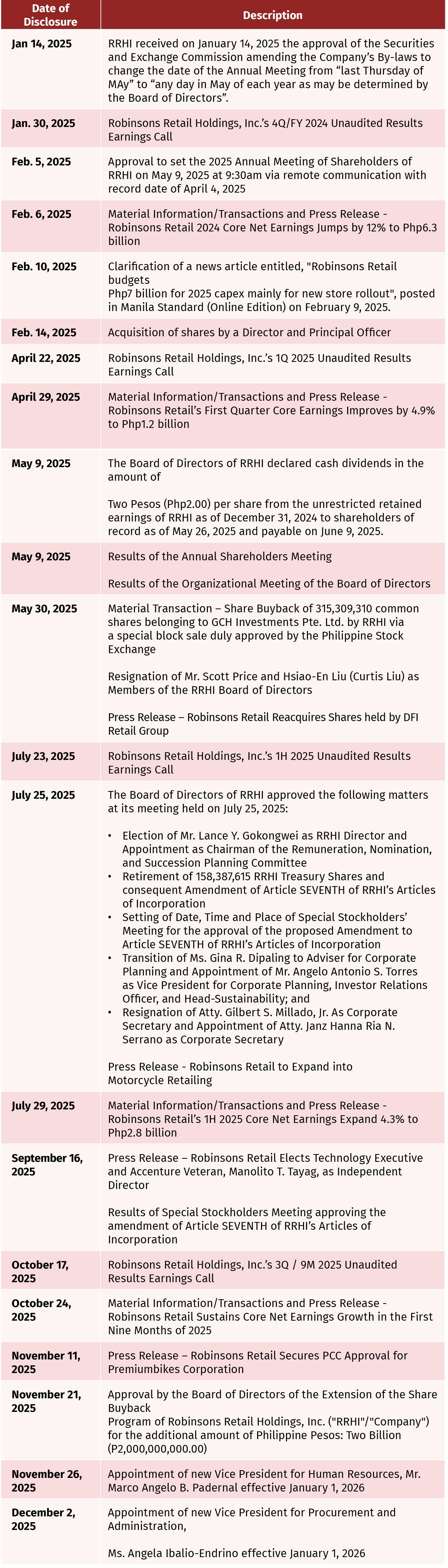
The Board has five independent directors that possess all the necessary qualifications and none of the disqualifications to hold the position, with two independent directors added in 2020. The Company reinforce proper mechanisms for disclosure, protection of the rights of shareholders, equitable treatment of shareholders, and the accountability of the Board and Management are in place. In cases of conflicts of interest, Directors with a material interest in any transaction with the Company abstain from participating in the deliberation of the same.
Board Training and OrientationThe Company ensures that directors are able to perform their functions effectively in this rapidly changing environment to cope with heightened regulatory policies, foreign and local demands, and the growing complexity of the business. Orientation programs are conducted for first time directors to ensure that new members are appropriately apprised of their duties and responsibilities. This includes overview of the Company’s operations, Code of Conduct, Corporate Governance framework and other relevant topics essential in the performance of their functions. As a matter of continuous professional education, the Company facilitates the training opportunities provided for the Directors and Key Officers.
Board Meetings
The Board schedules meetings at the beginning of the year,
holds regular meetings in accordance with its By-Laws and
convene special meetings when required by business exigencies.
The notice and agenda of the meeting and other relevant
meeting materials are furnished to the Directors at least five
(5) business days prior to each meeting. Meetings are duly
minuted. The Independent Directors shall always attend Board
meetings. Unless otherwise provided in the By-Laws, their
absence shall not affect the quorum requirement. However, the
Board may, to promote transparency, require the presence of at
least one (1) Independent Director in all its meetings.
To monitor the Directors’ compliance with the attendance
requirements, the Company submits to the Commission an
advisement letter on the Directors’ record of attendance in
Board meetings.
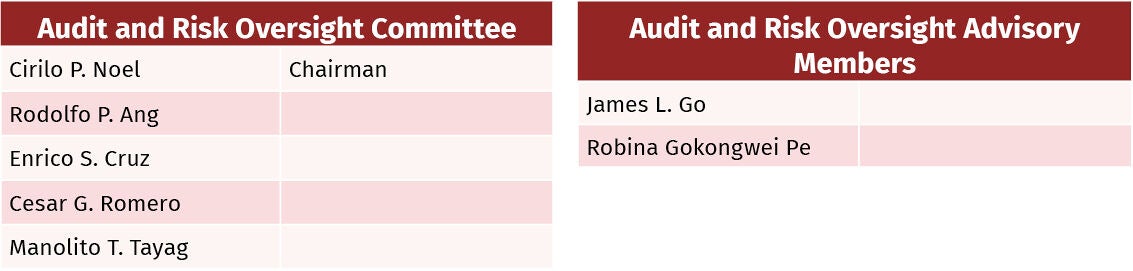
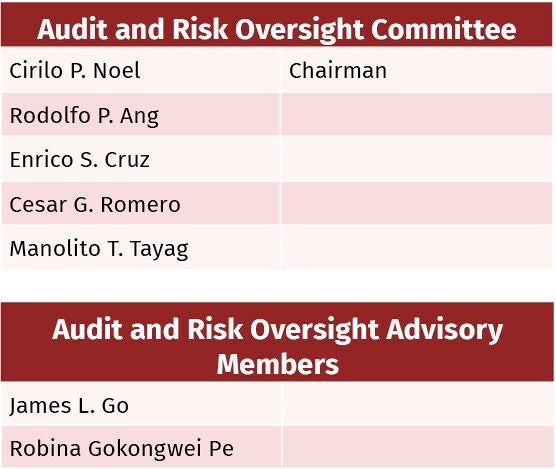
This Audit and Risk Oversight Committee Charter (this
“Charter”) establishes the purpose, qualifications and
membership, structure and operations, duties and
responsibilities of the Audit and Risk Oversight Committee
(the “Committee”) of Robinsons Retail Holdings, Inc. (the
“Company”), and the procedures which guide the conduct of its
functions.
The purpose of the Audit and Risk Oversight Committee are as
follows:
- To provide oversight over the Company’s financial reporting, Internal Control System, and Internal and External Audit processes. It shall ensure that systems and processes are in place to provide assurance activities, ensure accurate financial reporting, monitor compliance with laws, regulations and internal policies, determine the efficiency and effectiveness of business operations, and provide the proper safeguarding and use of the Company’s resources and assets; and
-
To oversee the establishment of an ERM framework to
identify, monitor, assess and manage key business risks.
The ERM framework shall guide the Company in identifying
units/business lines and enterprise-level risk exposures,
as well as the effectiveness of risk management
strategies. It shall be responsible for defining the
Company’s level of risk tolerance and providing oversight
over its risk management policies and procedures to
anticipate, minimize, control or manage risks or possible
threats to its operations
and performance.
 responsibilities
ERM Board Oversight
responsibilities
ERM Board Oversight
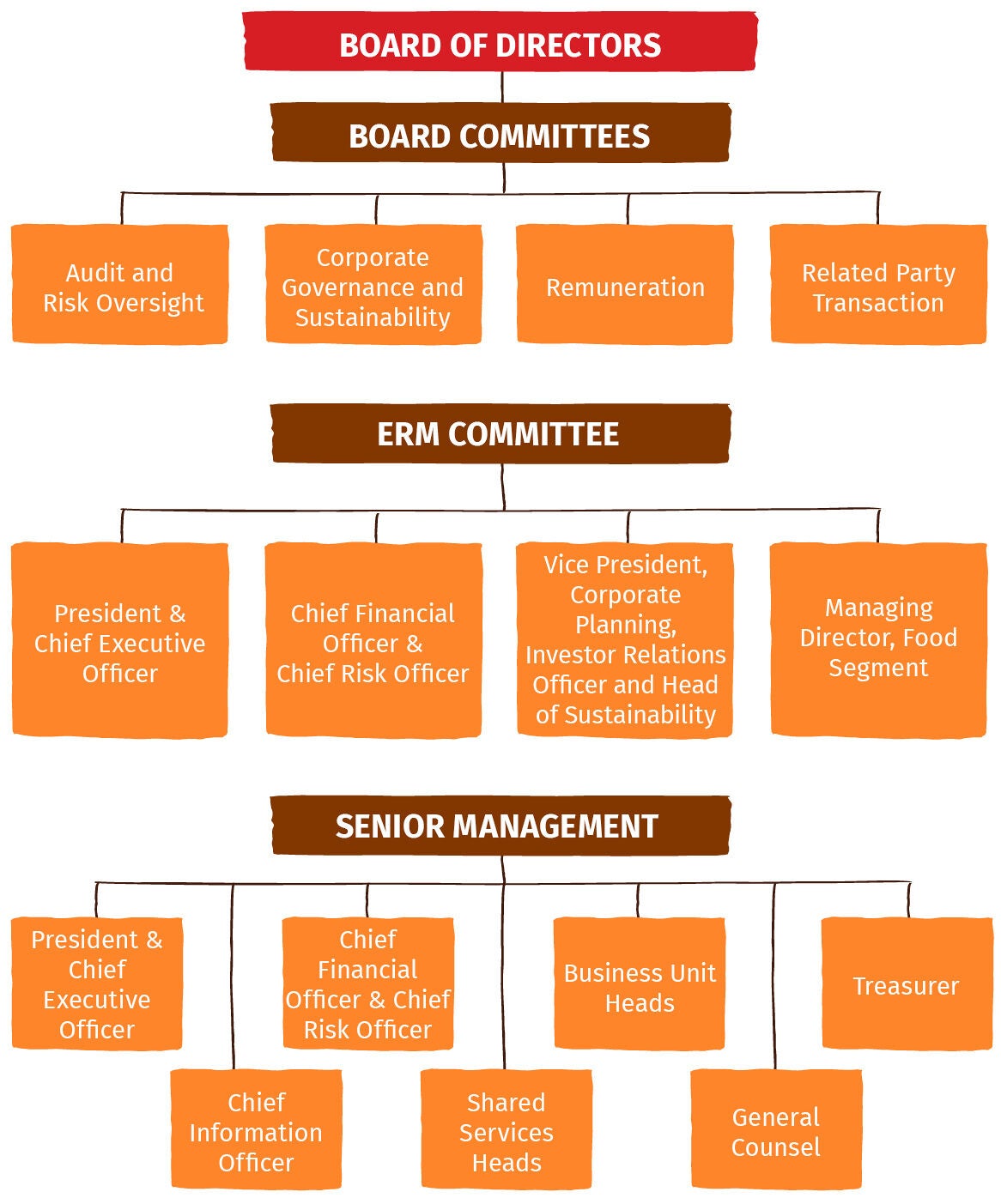
The Board of Directors and its various committees provide oversight and guidance on material risks and mitigation strategies, with ERM specifically guided by the Audit & Risk Committee through biannual meetings. The BOD receives regular updates from the ERM Committee, Senior Management and key risk functions.
ERM Committee
The ERM Committee, led by the Chief Risk Officer (CRO),
reviews and assesses the identified enterprise risks in
order to formulate plans, establish mitigation strategies
and institutionalize monitoring processes both at the
business unit and enterprise level.
Alongside the CRO, its current structure is composed of the
President & CEO, ensuring that risks and opportunities
have high visibility at the top level in operations. The
Managing Director of the Food Segment is likewise part of
the committee, given its scale of operations and revenue
contribution, where any associated risks to the segment
would have material impacts to the whole Company.
Lastly, the Vice President for Corporate Planning, Investor
Relations, and Head of Sustainability is likewise part of
the ERM Committee, with its mandate in strategy development,
stakeholder management, and ESG informing the structure of
ERM and its related disclosures.
Senior Management
Members of the Senior Management include the members of the ERM Committee, the Shared Services Heads and other Business Unit Heads. The main responsibility of Senior Management is to establish internal controls and execute procedures to identify, assess and manage events that may pose a risk to the business units of the Company. Related risk functions and risk owners on an operational level are likewise tasked to analyze risks and how to mitigate them. This allows for measures, if necessary, to be implemented in a timely and comprehensive manner when risk events occur.
The Chief Risk Officer
Robinsons Retail’s Chief Financial Officer concurrently acts as the Chief Risk Officer or CRO, who serves as the direct point person for managing the Company’s material risks. They ensure that all risk management strategies are implemented and monitored at the business unit and enterprise level. Working closely with the Board of Directors Committee on Audit and Risk and members of Senior Management, the CRO relies on the detailed identification and assessment of risks by the key risk owners to effectively implement mitigation measures.
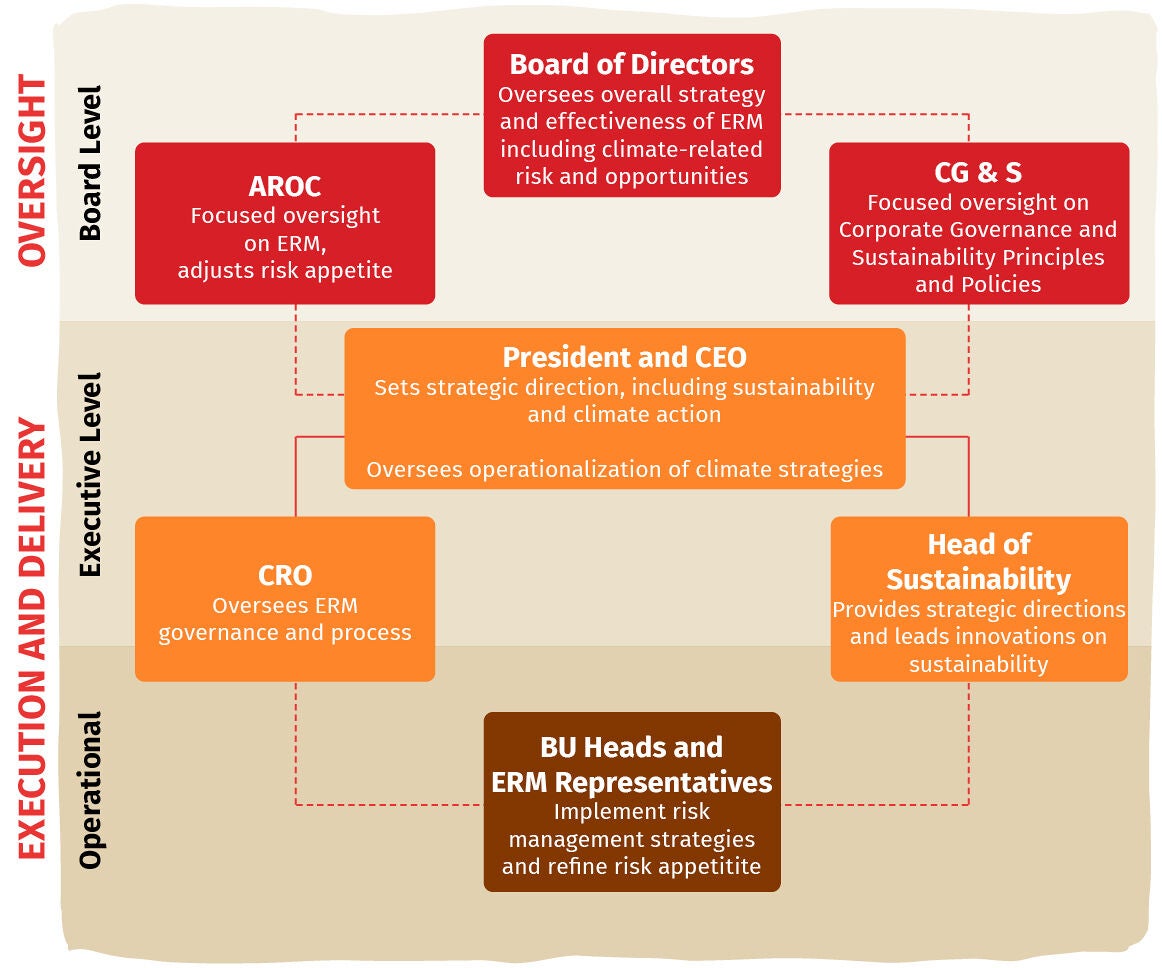
We recognize the critical role of climate governance in
navigating the evolving challenges of climate change. Our
leadership structure enables proactive management of
potential risks posed by climate change, while
simultaneously identifying and seizing new opportunities.
Our governance structure enables informed decision-making at
multiple levels:
- Board Oversight: The Board provides top-level oversight, ensuring the effectiveness of our overall climate strategy.
- Management Execution: Management focuses on integrating the climate agenda throughout the whole portfolio, and reports progress to the Board.
- Operational Integration: Business units implement the climate-related strategy, ensuring its integration within day-to-day activities and alignment with corporate goals.
The
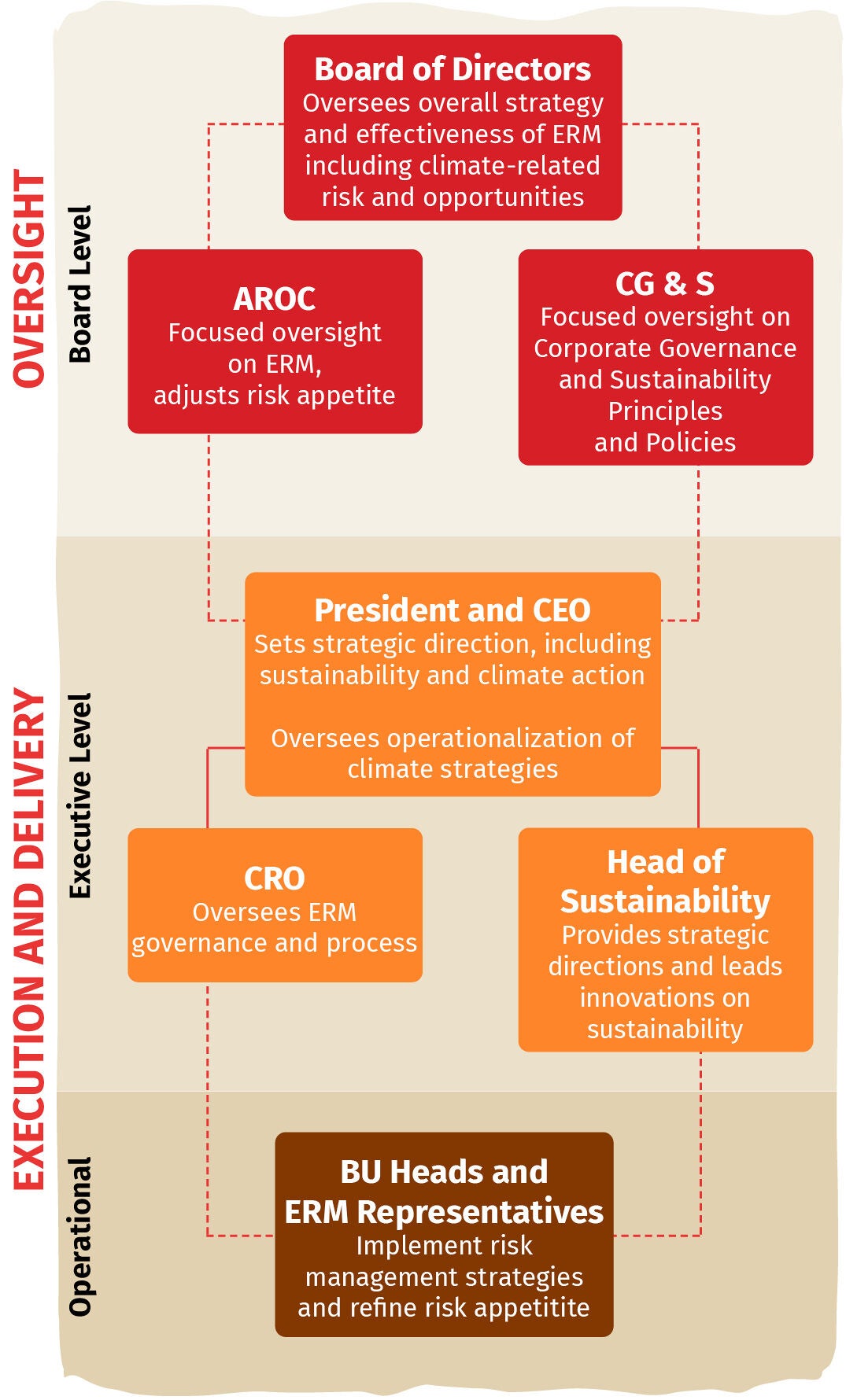
Board of Directors
oversees the management of climate-related risks and
opportunities, ensuring that climate considerations are
seamlessly integrated into our strategies, procedures, and
systems. The Board, through the
Audit and Risk Oversight Committee (AROC)
, evaluates management's actions on risk matters. The AROC
oversees the ERM framework, ensuring policies adequately
address climate-related risks for both operational and
financial resilience. It also guides the development,
implementation, and evaluation of our climate-related risk
management plans.
Supporting the Board alongside AROC is the
Corporate Governance and Sustainability Committee (CG&S)
, which oversees the development and implementation of
corporate governance principles and policies, with a focus
on the Economic, Environment, Social, and Governance (EESG)
aspects of sustainability. It also evaluates management's
effectiveness in maximizing climate-related opportunities.
The
President and Chief Executive Officer (CEO)
sets the overall strategic direction for the conglomerate,
including our approach to sustainability and climate action,
playing a central role in driving climate initiatives,
managing climate risks, and ensuring transparent reporting
on our climate performance. The President and CEO also
oversees the operationalization of climate strategies across
the different business units.
The
Chief Risk Officer (CRO)
oversees our ERM processes, establishing a robust framework
for managing climate-related risks.
The
VP for Corporate Planning and Head of Sustainability
develops strategies that align with the company's
sustainability goals and commitments, including those
related to climate change mitigation and adaptation. The
Head of Sustainability also ensures that climate
considerations are integrated into the company's broader
business strategy. The head also designs and leads the
development of our Climate Resilience and Transition plans
within which relevant risks and opportunities are identified
and then help the business units achieve climate-related
targets. The head coordinates with the COO and the business
unit heads in the effective implementation of climate
strategies.
Our
Business Unit Heads
play a vital role in operationalizing our climate resilience
strategies. Through the leadership of the CEO and guidance
from the CRO and Head of Sustainability, the Business Unit
Heads implement and continuously refine risk management
strategies to address climate-related challenges within
their specific business areas.
Our Enterprise Risk Management (ERM) strategy takes a holistic approach to both addressing climate-related risks and maximizing climate-related opportunities within our framework. Our comprehensive process embeds the identification, assessment, and management of climate-related risks and opportunities into the overall ERM framework through the following steps: 1) Risk Identification, 2) Risk Assessment, 3) Risk Prioritization, and 4) Risk Response, Monitoring, and Evaluation.
- a. Integration of climate-related risk and opportunity management to the overall Enterprise Risk Management
Climate-related risks and opportunities are integrated into our ERM system and managed at both the Management and BU Level. Identified as a Climate Risk category in the Group's risk register allows us increased focus on climate risk identification and mitigation. Climate risk assessment and climate scenario analysis (CSA) is being integrated into our overall ERM system by identifying physical risks, evaluating impact, prioritizing urgency, and executing resilience strategies, which is articulated by the figure below.
- b. Risk Identification, Assessment, and Prioritization
We established a risk assessment scale categorizing impacts
as insignificant to extreme and likelihoods from rare to
almost certain, tailored by each operating company to their
specific context and risk appetite, streamlining the risk
rating process. Risks were assessed for severity based on
impact and likelihood, focusing on their inherent nature,
independent of our specific circumstances or management
capacity. Priority was given to risks with high to very high
severity, considering our organization's risk profile,
vulnerability, and their urgency. This assessment
prioritizes the company's most critical assets by
pinpointing their exposure to climate hazards. Using
detailed climate models and scenarios (RCP 4.5 and 8.5), it
then quantifies the potential impacts on these assets
through specialized tools. In short, it identifies weak
spots and measures potential damage from climate change.
Climate-related physical and transition risks are included
in our recent risk register. Climate-related risks pose
potential adverse impact to operations, particularly in the
face of extreme weather events. Regulatory changes linked
climate change, such as carbon pricing, emissions caps, and
extended producer responsibility, may impact operations by
escalating compliance costs. The insights from the CSA are
being incorporated into the group's ERM system, enhancing
our management of climate-related risks and opportunities.
This integration deepens our understanding of the potential
likelihood and severity of climate risks, enabling more
informed decision-making in prioritizing and response
planning.
- c. Risk Response, Monitoring, and Evaluation
We ensure the implementation of suitable risk responses for
each climate-related risk, both at the BU level and at the
enterprise-wide level. Risk owners are responsible for
managing climate-related risks and collaborate with risk
champions to develop effective management strategies to
reduce environmental impact and adapt to climate threats.
The head of sustainability will be leading the cascade of
our recently concluded CSA to the business units risk owners
to ensure effective integration of climate risk assessment
in the overall operations of the business units.
Continuous monitoring of legislative proposals and
regulatory trends is in place, ensuring timely
identification of potential effects on operations. We also
continuously integrating the identified climate-related
risks specifically extreme weather events into our business
continuity plans and crisis management plans to ensure
group’s resiliency.
- d. Opportunity Management Process
We are proactively anticipating future climate conditions,
identifying opportunities arising from changing consumer
behaviors, new market developments, and innovations aligned
with ongoing climate trends. This process includes a
thorough evaluation of potential climate-related
opportunities, pinpointing those that complement the
company's core strengths, contextual relevance, and
prevailing market trends.
Each identified opportunity will be assessed for its
financial, operational, and reputational implications to
gauge its feasibility. We will rank these opportunities
according to how well they align with our corporate and
sustainability objectives, evaluating their feasibility,
potential for expansion, and compatibility with current
business initiatives.
To stay ahead, we will regularly revise and updates our
approach at least semi-annually in response
to changing climate conditions and market shifts. This
continuous monitoring and refinement highlight our
commitment to actively evolving landscape of climate-related
opportunities.
- e. Changes in Risk Identification, Assessment, Prioritization, and Monitoring
We continuously enhance our risk management system, demonstrating commitment to addressing evolving challenges. Documentation of controls in place against identified risks and ranking of the top risks are priorities. Notably, in this latest reporting period, we have integrated climate scenario analysis into our risk identification and assessment processes. This strategic initiative has empowered us to proactively anticipate and address potential climate-related risks.
Metrics and Targets
To provide our shareholders and stakeholders clear insights into our approach to managing climate-related risks and opportunities, we have set specific environmental and climate-related targets and are tracking our progress.
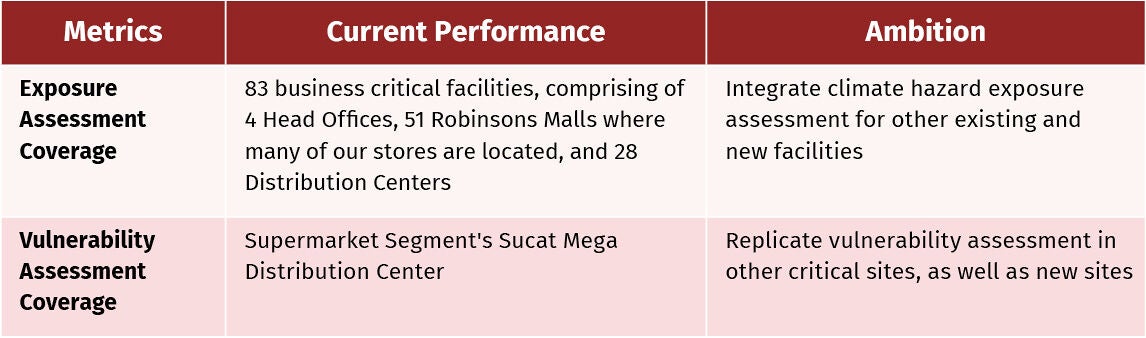
- a. Metrics and Targets for Physical Risks
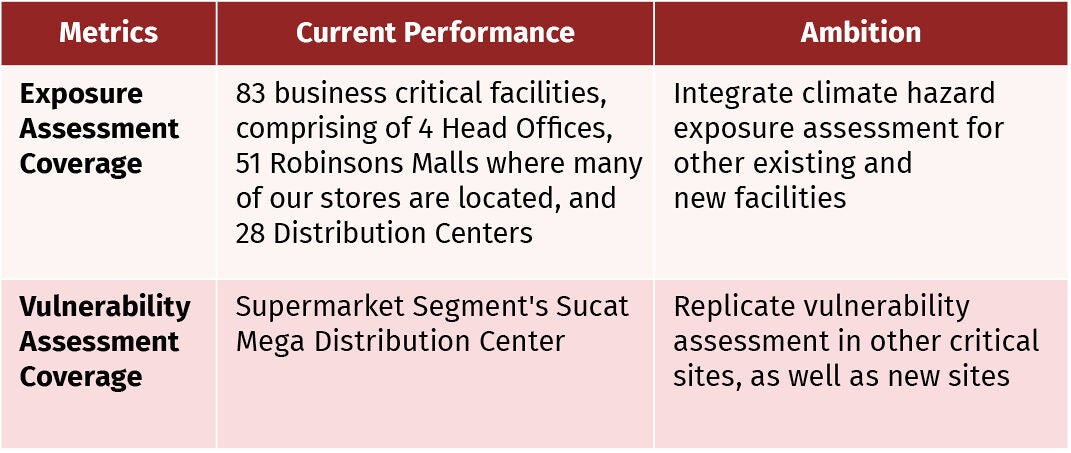
To demonstrate our approach in managing the physical climate-related risks, we reflected metrics for exposure assessment coverage and vulnerability assessment coverage associated with flooding, tropical cyclones, extreme temperature and heat stress, and sea level rise.
- b. GHG Emissions Metrics and Targets
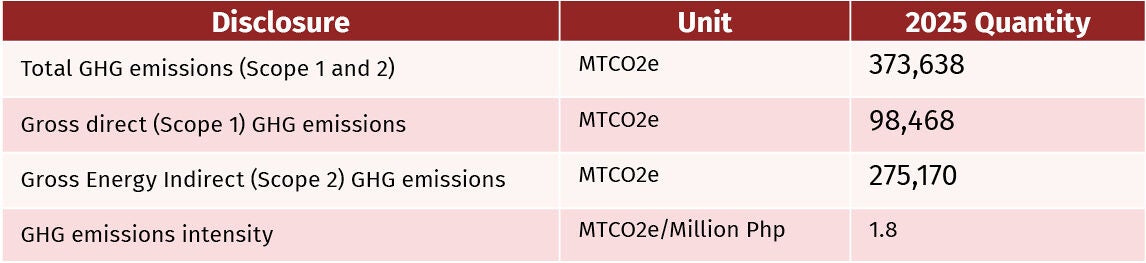
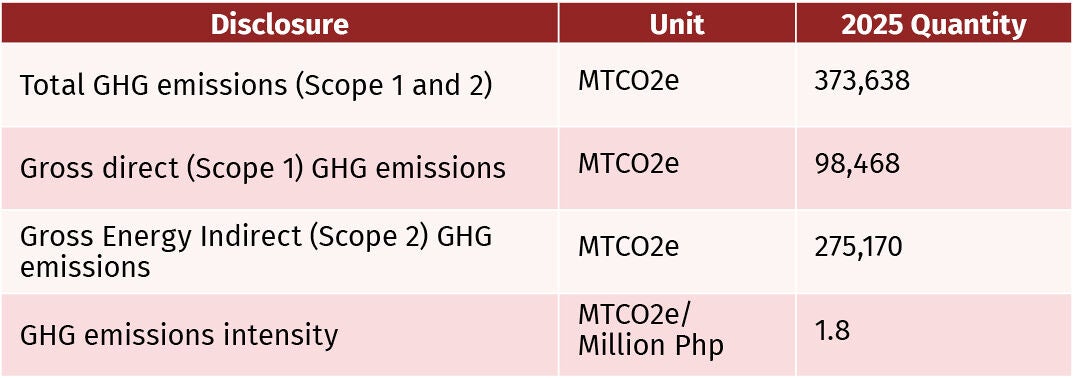
We calculate our total greenhouse gas (GHG) emissions using
the operational control approach, covering the measurement
and disclosure of Scope 1 and Scope 2 emissions. Scope 2
emissions are reported using a location‑based methodology.
While selected Scope 3 emission categories were previously
disclosed, we have opted not to present Scope 3 data in this
reporting cycle as we recalibrate our approach. We intend to
conduct a comprehensive Scope 3 baselining exercise
beginning in 2026, with initial completion targeted in 2027,
to establish a more complete and decision‑useful inventory
of value chain emissions.
In 2023, we commenced foundational work to strengthen our
climate‑related data management, governance structures, and
risk and opportunity assessment processes. These activities
are intended to support the future development of a climate
transition roadmap. The timeline, scope, and level of
ambition of future climate targets will be determined once
these preparatory efforts are sufficiently advanced, and in
consideration of emerging regulatory requirements, data
readiness, and business priorities.
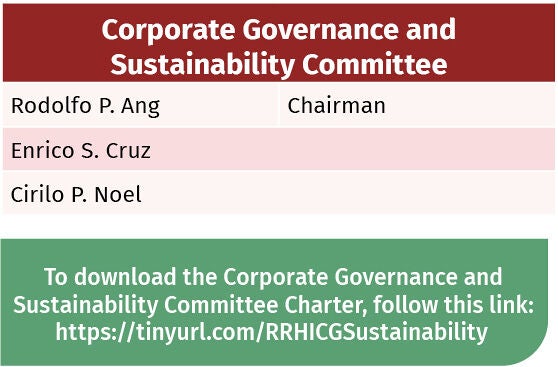
Corporate Governance and Sustainability Committee
This Corporate Governance and Sustainability Committee
Charter (this “Charter”) establishes the purpose,
qualifications and membership, structure and operations,
duties and responsibilities of the Corporate Governance and
Sustainability Committee (the “Committee”) of Robinsons
Retail Holdings, Inc. (the “Company”), and the procedures
which guide the conduct of its functions.
The purpose of the Corporate Governance and Sustainability Committee is to oversee the development and implementation of Corporate Governance principles and policies and perform oversight functions on the Economic, Environment, Social and Governance aspects of sustainability. The Corporate Governance and Sustainability Committee shall recommend a formal framework on the nomination, and evaluation of the performance of the Directors Officers and Senior Management to ensure that this framework is consistent with the Company’s culture, strategies and the business environment.
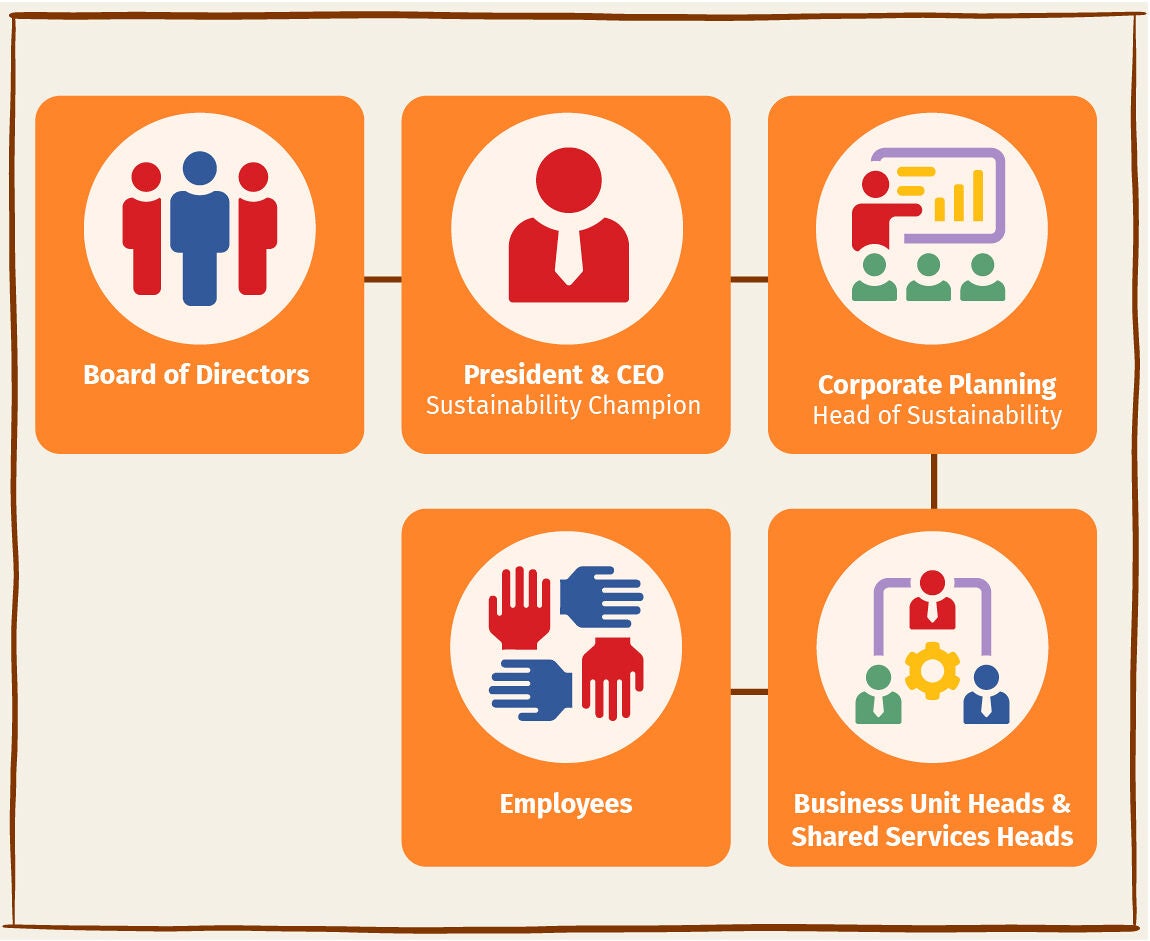
In RRHI, the President and CEO of the company, who directly reports to the Board of Directors, has been appointed with oversight over economic, social, and environmental topics. Any top-level directives and decisions are cascaded down to our Corporate Planning team, which in turn disseminates information and strategizes sustainability initiatives with the Business Unit and Shared Services Heads of the company, who then further cascade sustainability to their respective employees. The Corporate Planning Department will facilitate efforts among the Business Units and Shared Services Departments to further foster a culture of Sustainability within the RRHI, facilitate data-gathering and monitoring of ESG metrics, as well as serve as the liaison body between RRHI and the Gokongwei Group on topics and issues related to Sustainability.
Remuneration, nomination, and succession planning Committee
This Remuneration, Nomination and Succession Planning
Committee Charter (this “Charter”) establishes the purpose,
qualifications and membership, structure and operations,
duties and responsibilities of the Remuneration, Nomination,
and Succession Planning Committee (the “Committee”) of
Robinsons Retail Holdings, Inc. (the “Company”), and the
procedures which guide the conduct of its functions.
The purpose of the Remuneration, Nomination and Succession Planning Committee is to formulate a remuneration policy and establish a formal framework for the nomination and evaluation of the performance of Directors, Officers, and Senior Management. The Remuneration, Nomination and Succession Planning Committee aims to develop the required competencies through planned developmental and learning initiatives guided by the Company’s vision and mission. It shall implement the remuneration policy with the authority, in conjunction with internal and external advisers, to ensure the Board’s objectives are met. Furthermore, it is tasked with recommending and evaluating candidates for Directors, Officers, and Senior Management, ensuring competence, and fostering long-term success for the Company to maintain competitiveness.
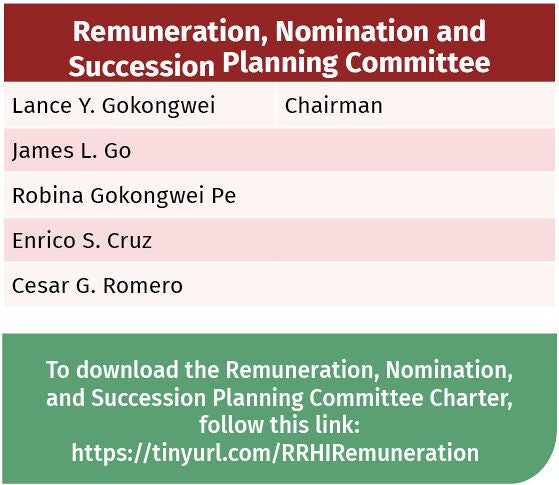
This Related Party Transaction Committee Charter (this
“Charter”) establishes the purpose, qualifications and
membership, structure and operations, duties and
responsibilities of the Related Party Transaction Committee
(the “Committee”) of Robinsons Retail Holdings, Inc. (the
“Company”), and the procedures which guide the conduct of
its functions.
The purpose of the Related Party Transaction (RPT) Committee is to ensure that there is group-wide policy and system governing Material Related Party Transactions (MRPTs), particularly those that breach the materiality threshold. The policy shall include the appropriate review and approval of MRPTs, which guarantee fairness and transparency of the transactions.
January 1, 2025 to December 31, 2025
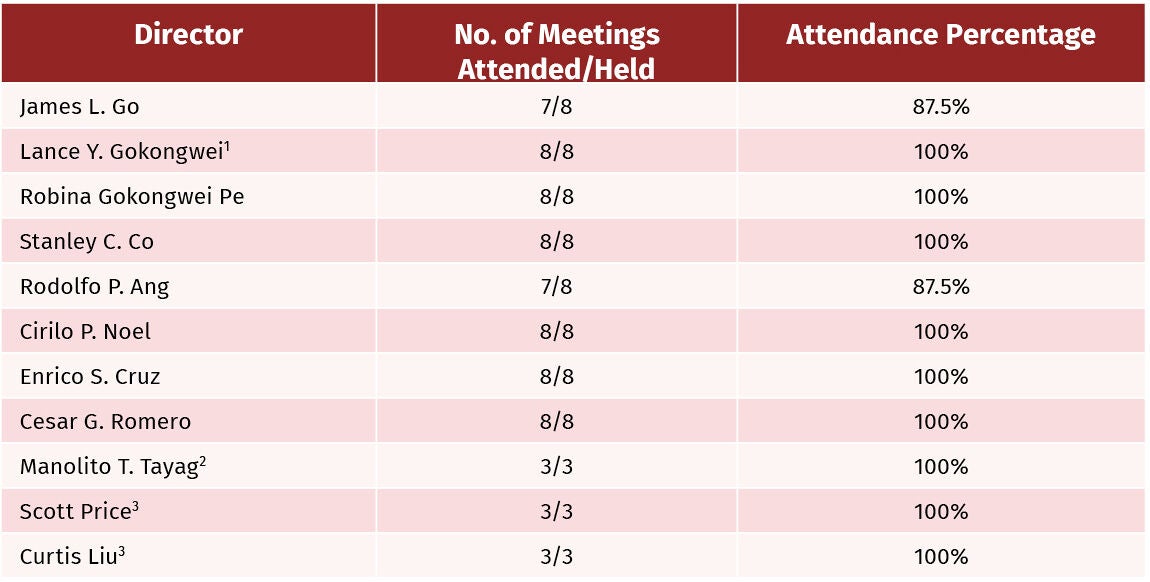
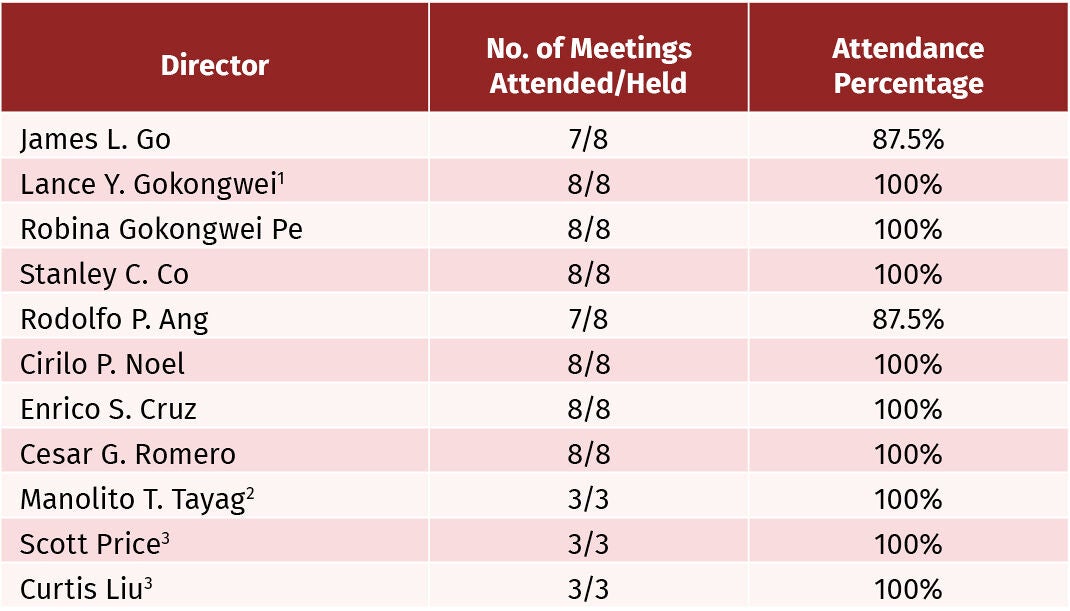
1 From January 1, 2025 to July 25, 2025, Mr. Lance Gokongwei
served and attended meetings as RRHI Board Adviser. He was
elected as member of the RRHI Board of Directors effective
July 25, 2025.
2 Mr. Manolito T. Tayag was elected Independent Director of
RRHI effective September 16, 2025.
3 Mr. Scott Price and Mr. Curtis Liu ceased to be Directors
of the RRHI effective May 30, 2025 following the share
buyback of the RRHI shares owned by GCH Investments Limited
Pte. under a special block sale duly approved by the
Philippine Stock Exchange
he Company recognizes that a competent and experienced Board
is fundamental to effective governance, long-term
performance, and sustainable growth. Accordingly, the
Board’s remuneration framework is designed to attract and
retain qualified directors while ensuring that compensation
practices remain fair, transparent, and aligned with
industry benchmarks and the responsibilities entrusted to
the Board.
Directors are compensated through a combination of fixed
retainer fees and meeting attendance fees, reflecting both
their role and level of engagement. Non-nominee directors
receive an annual retainer fee of Php600,000, along with a
per diem of Php60,000 for each Board and shareholders’
meeting attended and Php30,000 for each committee meeting.
In recognition of the additional responsibilities of the
role, the Lead Independent Director receives an annual
retainer of Php800,000, Php80,000 per Board and
shareholders’ meeting, and Php40,000 per committee meeting.
Independent Directors are provided an annual retainer of
Php700,000, a per diem of Php70,000 for each Board and
shareholders’ meeting, and Php35,000 for each committee
meeting.
This remuneration structure supports equitable treatment
among directors, reflects differing levels of
responsibility, and reinforces the Board’s commitment to
good governance and accountability.
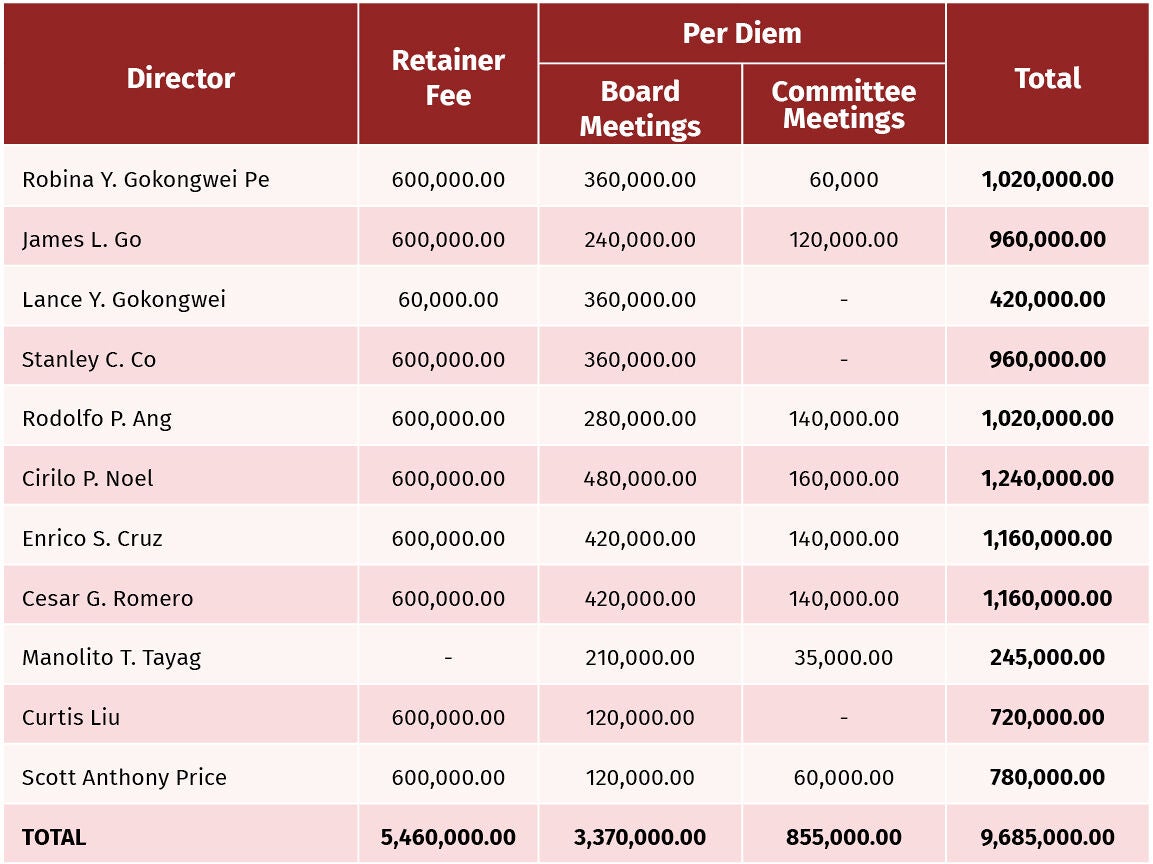
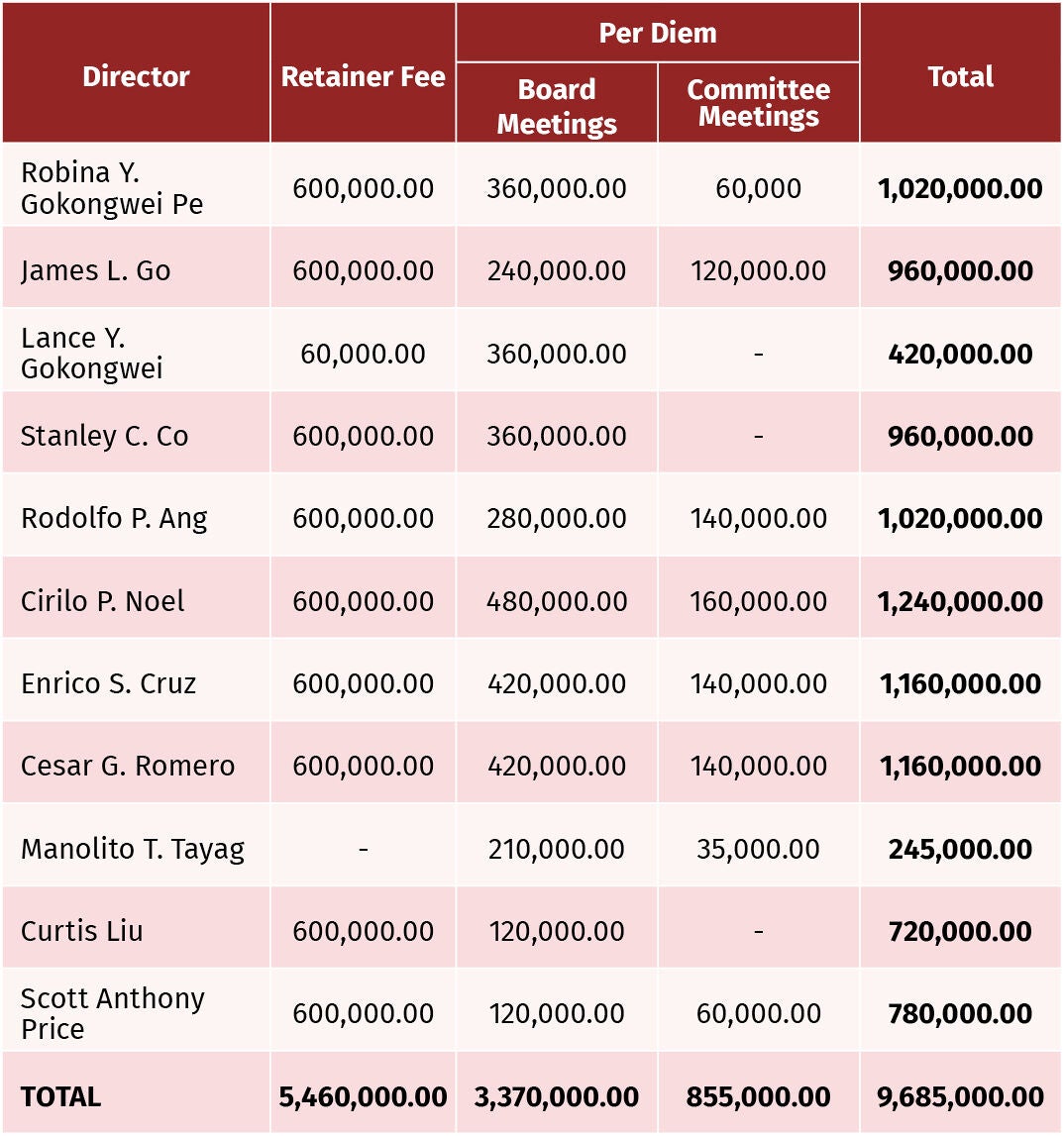
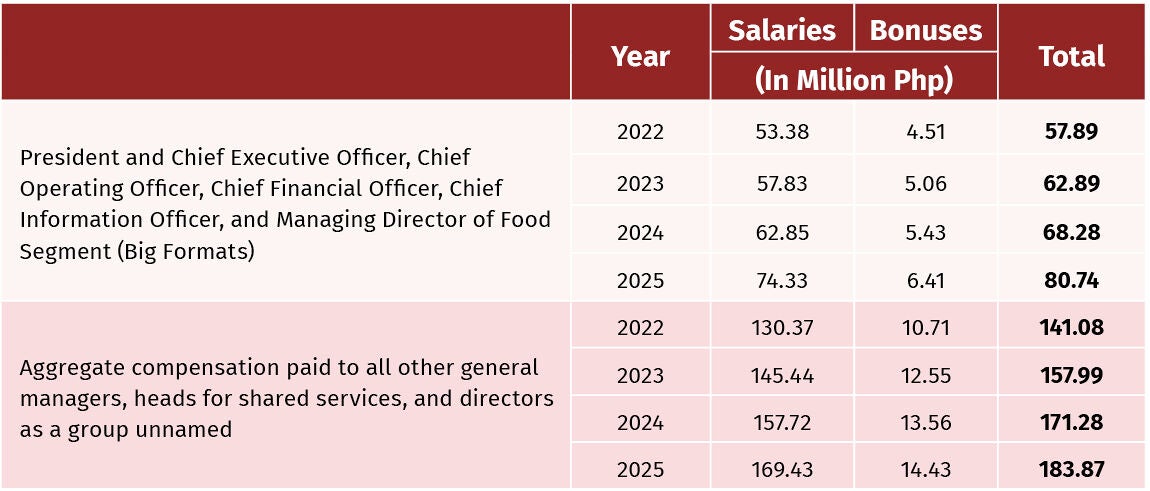
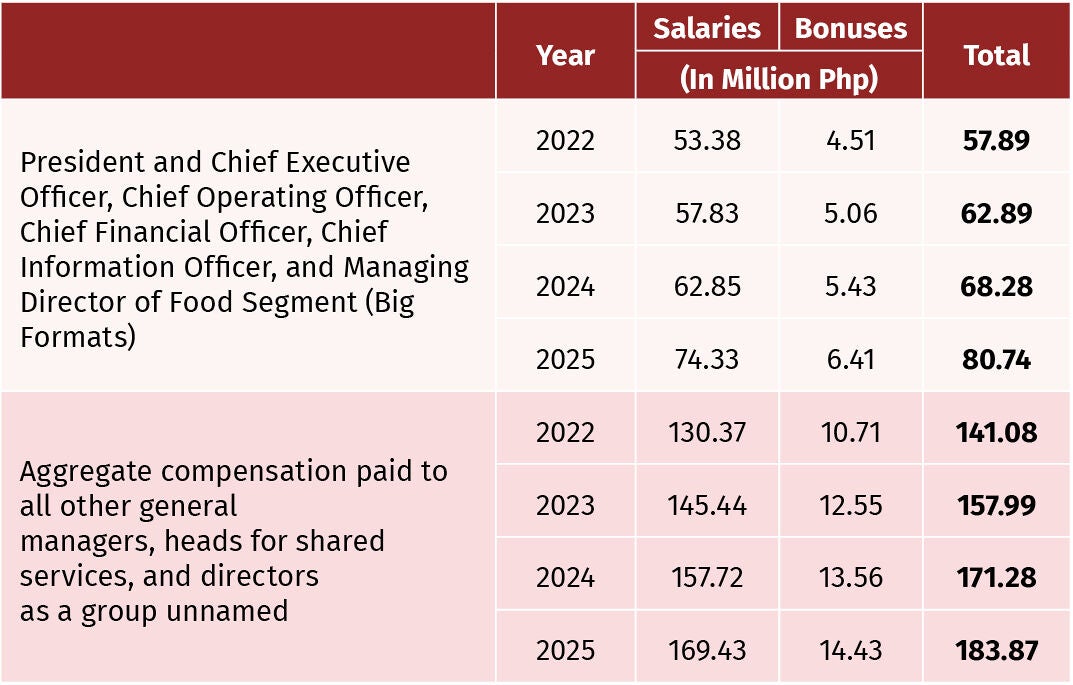
Meanwhile, the aggregate compensation of executive officers and directors of the Company for 2025 is shown below.
 Stakeholders Welfare, Transparency, and
Anti-Corruption
Stakeholders Welfare, Transparency, and
Anti-Corruption
Robinsons Retail Holdings, Inc. (“The Company”) acknowledges
that good corporate governance is essential to build an
environment of trust, transparency and accountability
necessary for fostering long-term performance, financial
stability, business integrity and sustainability of the
company for the protection of the interests of shareholders
and other stakeholders.
The Company believes that sound and effective corporate
practices are fundamental to the smooth, effective and
transparent operation of the company, its ability to attract
investment and enhance shareholder value. This includes the
Company’s commitment to ensure fair and equitable treatment
of all shareholders, including the minority, and the
protection of their rights that include:
- Right to vote on all matters that require their consent or approval
- Right to nominate, elect, remove, and replace directors in accordance with the Corporation Code
-
Right to inspect corporate books and records
- Right to information
- Right to dividends
- Appraisal right
With the leadership of the Company’s Chief Financial Officer (CFO), internal control is embedded in the operations of the company and in each BU thus increasing their accountability and ownership in the execution of the BU’s internal control framework. To accomplish the established goals and objectives, BUs implement robust and efficient process controls to ensure:
- Compliance with policies, procedures, laws and regulations
- Economic and efficient use of resources
-
Check and balance and proper segregation of duties
- Identification and remediation control weaknesses
- Reliability and integrity of information
- Proper safeguarding of company resources and protection of company asset s through early detection and prevention of fraud
To enable the Directors to properly fulfill their duties and
responsibilities, Management provides the Directors with
complete, adequate, and timely information about the matters
to be taken up in their meetings. Information may include
the background or explanation on matters brought before the
Board, disclosures, budgets, forecasts, and internal
financial documents. If the information provided by
Management is not sufficient, further inquiries may be made
by a Director to enable him to properly perform his duties
and responsibilities.
The Directors have independent access to Management and to
the Corporate Secretary. The Directors, either individually
or as a Board, and in the performance of their duties and
responsibilities, may seek access to independent
professional advice within the guidelines set by the Board.
The Board ensures that its Shareholders are provided with a balanced and comprehensible assessment of the Company’s performance, position and prospects on a quarterly basis. Interim and other reports that could adversely affect its business are also made available in the Company website including its submissions and disclosures to the SEC and PSE. Management formulates the rules and procedures on financial reporting and internal control for presentation to the Audit Committee in accordance with the following guidelines:
- The extent of its responsibility in the preparation of the financial statements of the Company, with the corresponding delineation of the responsibilities that pertain to the External Auditor, should be clearly defined;
- An effective system of internal control that will ensure the integrity of the financial reports and protection of the assets of the Company for the benefit of all Shareholders and other Stakeholders;
-
On the basis of the approved Internal Audit Plan,
Internal Audit examinations should cover, at the
minimum, the evaluation of the adequacy and
effectiveness of controls that cover the Company’s
governance, operations and information systems,
including the reliability and integrity of financial and
operation information, effectiveness and efficiency of
operations, protection of assets, and compliance with
contracts, laws, rules, and regulations;
- The Company consistently complies with the financial reporting requirements of the SEC;
- The External Auditor shall be rotated or changed every five (5) years or earlier, or the signing partner of the External Auditing firm assigned to the Company, should be changed with the same frequency. The Corporate IA Head should submit to the Audit Committee and Management an annual report on the Internal Audit department’s activities, responsibilities, and performance relative to the Internal Audit Plan as approved by the Audit and Risk Committee. The annual report should include significant risk exposures, control issues, and such other matters as may be needed or requested by the Board and Management. The Internal Audit Head should certify that he conducts his activities in accordance with the International Standards on the Professional Practice of Internal Auditing. If he does not, the Internal Audit Head shall disclose to the Board and Management the reasons why he has not fully complied with the said documents; and
-
The Board, after consultations with the Audit Committee
shall recommend to the Shareholders an External Auditor
duly accredited by the SEC who shall undertake an
independent audit of the Company, and shall provide an
objective assurance on the matter by which the financial
statements shall be prepared and presented to the
Shareholders.
The Corporate Internal Audit is focused on delivering its mandate of determining whether the governance, risk management and control processes, as designed and represented by management, are adequate and functioning in a manner that provides reasonable level of confidence that:
- Employees’ actions are compliant with policies, standards, procedures, and applicable laws and regulations;
- Quality and continuous improvement are fostered in the control processes;
-
Programs, plans, and objectives are achieved; Resources
are acquired economically, used efficiently, and
protected adequately;
- Resources are acquired economically, used efficiently, and protected adequately;
- Significant financial, managerial, and operating information is accurate, reliable, and timely;
- Significant key risks are appropriately identified and managed; and
- Significant legislative or regulatory issues impacting the Company are recognized and properly addressed.
Opportunities for improving management control, profitability and the Company’s reputation may be identified during audits.
Notice of Annual and Special Shareholders’ Meeting
The Company is transparent and fair in the conduct of the
annual and special Shareholders’ meetings. To foster active
shareholder participation, the Board sends the Notice of
Annual and Special Shareholders’ Meeting with sufficient and
relevant information at least twenty-eight (28) days before
the meeting. The Shareholders are encouraged to personally
attend such meetings and those who are unable to attend are
apprised ahead of time of their right to appoint a proxy.
Subject to the requirements of law, rules and regulations
and the By-Laws, the exercise of that right shall not be
unduly restricted and any doubt about the validity of a
proxy shall be resolved in the favor of the shareholder.
Guided by the principles of fairness, accountability and
transparency to the shareholding public, the Company ensures
that the result of the votes taken during the most recent
Annual or Special Shareholders’ Meeting are made available
the next working day. In addition, the Minutes of the Annual
and Special Shareholders’ Meeting may be accessed through
the Company Website within three (3) business days from the
end of the meeting.
The Company adopts customer relations policies and procedures to protect customer’s welfare. This includes providing and making available the customer relations contact information who is empowered to address and attend to customer questions and concerns.
Supplier/Contractor SelectionThe Company adopts customer relations policies and procedures to protect customer’s welfare. This includes providing and making available the customer relations contact information who is empowered to address and attend to customer questions and concerns. The Company recognizes and places importance on the interdependence between business and society, and promote a mutually beneficial relationship that encourages the Company’s sustainable growth, while contributing to the advancement of the society where it operates. The Company employs value chain processes that take into consideration Economic, Environmental and Social Governance (EESG) issues and concerns.
EmployeesThe Board also establishes policies, programs and procedures that encourage employees to actively participate in the realization of the Company’s goals and its governance including but not limited to:
- Health, safety and welfare;
- Training and development; and
-
Reward and compensation
The Company abides by the standards and policies set by the
Department of Labor and Employment. Likewise, the Company
has Security and Safety Manuals that are implemented,
reviewed and regularly updated to ensure the security,
safety, health, and welfare of the employees in the
workplace.
The Company continuously provides learning and development
opportunities for its employees through the John Gokongwei
Institute for Leadership and Enterprise Development
(JG-ILED), the leadership platform for systematic and
sustained development programs across the conglomerate. Its
mission is to enable a high performing organization that
will facilitate the learning process and develop the
intellectual and personal growth of all employees through
targeted and customized trainings and development programs.
The Company is committed to promoting transparency and
fairness to all stakeholders. The Board sets the tone and
make a stand against corrupt practices by adopting
anti-corruption policies and programs. Some of the Company’s
Anti-Corruption programs are embodied in the Code of
Business Conduct and Ethics, Conflict of Interest, Offenses
Subject to Disciplinary Action (OSDA), among others. The
same are disseminated to all employees across the Company
through trainings to embed them in the Company’s culture.
New employees are oriented regarding policies and procedures
related to Business Conduct and Ethics and similar policies.
All employees are given periodic reminders. Further, all
concerned employees of the Conglomerate are required to
comply with the Self-Disclosure Activity on Conflict of
Interest and Declaration of Gifts Received on an annual
basis.
The Company also has an established suitable framework for
whistleblowing and ensure its enforcement to allow employees
and other stakeholders to freely communicate their concerns
about illegal or unethical practices without fear of
retaliation, and to have direct access to an independent
member of the Board or a unit created to handle
whistleblowing concerns.
Company Policies
Code of Business Conduct and EthicsThe Company’s Code of Business Conduct and Conflicts of Interest Policy require employees to make a conscious effort to avoid conflict of interest situations; that his judgment and discretion is not influenced by considerations of personal gain or benefit. A conflict of interest may also occur because of the actions, employment, or investments of an immediate family member of an employee.
The Company’s employees that recommend, endorse, or approve the procurement or / sale of goods and services should make a conscious effort to avoid any conflict of interest situation in transactions that they are involved in.
The Company ensures that all transactions comply with relevant laws and regulations. Any deficiencies are immediately rectified.
The Company has policies that ensure proper and authorized disclosure of confidential information. Disclosures to the public can only be done after disclosure to the SEC and PSE by the Company’s authorized officers.
Employees are required to safeguard Company resources and assets with honesty and integrity. Employees must ensure that these assets are efficiently, effectively, and responsibly utilized.
The Company’s Human Resources Unit ensures compliance with employment and labor laws and policies.
Violation of any provision of the Code of Business Conduct may result to disciplinary action, including dismissal and reimbursement for any loss to the Company that results from the employee’s action. If appropriate, a violation may result in legal action against the employee or referral to the appropriate government authorities.
The Conflicts of Interest Committee submits recommendations on courses of action to be taken on conflicts of interest situations. Decision is done by the Executive Committee.
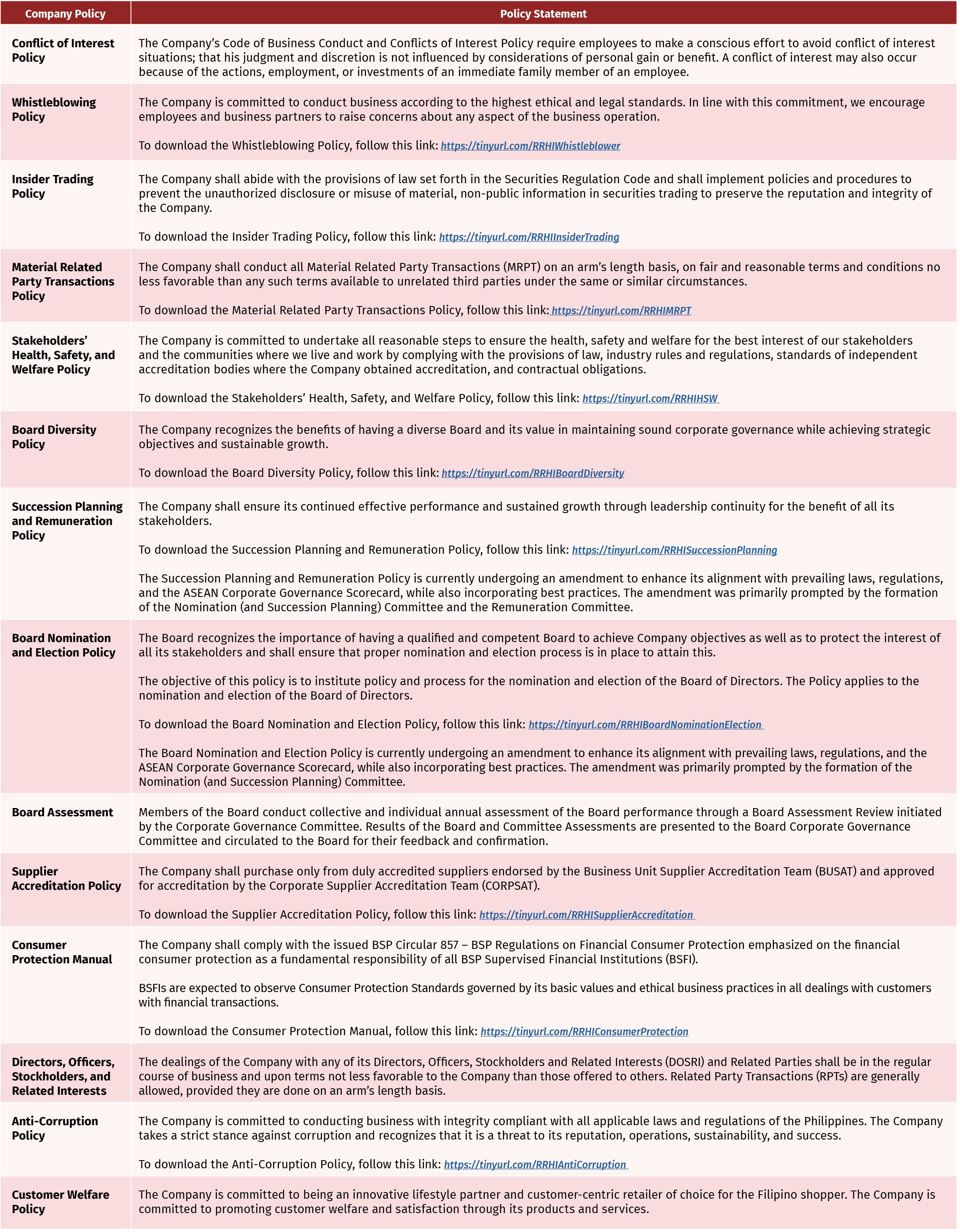
The complete list of company policies can be accessed publicly through the company’s website: Corporate Governance - Robinsons Retail Holdings, Inc.
 Insider Trading
The dealings of the Company with any of its Directors and
Key Officers are done on an arm’s length basis, and upon
terms not less favorable to the Company than those offered
to others.
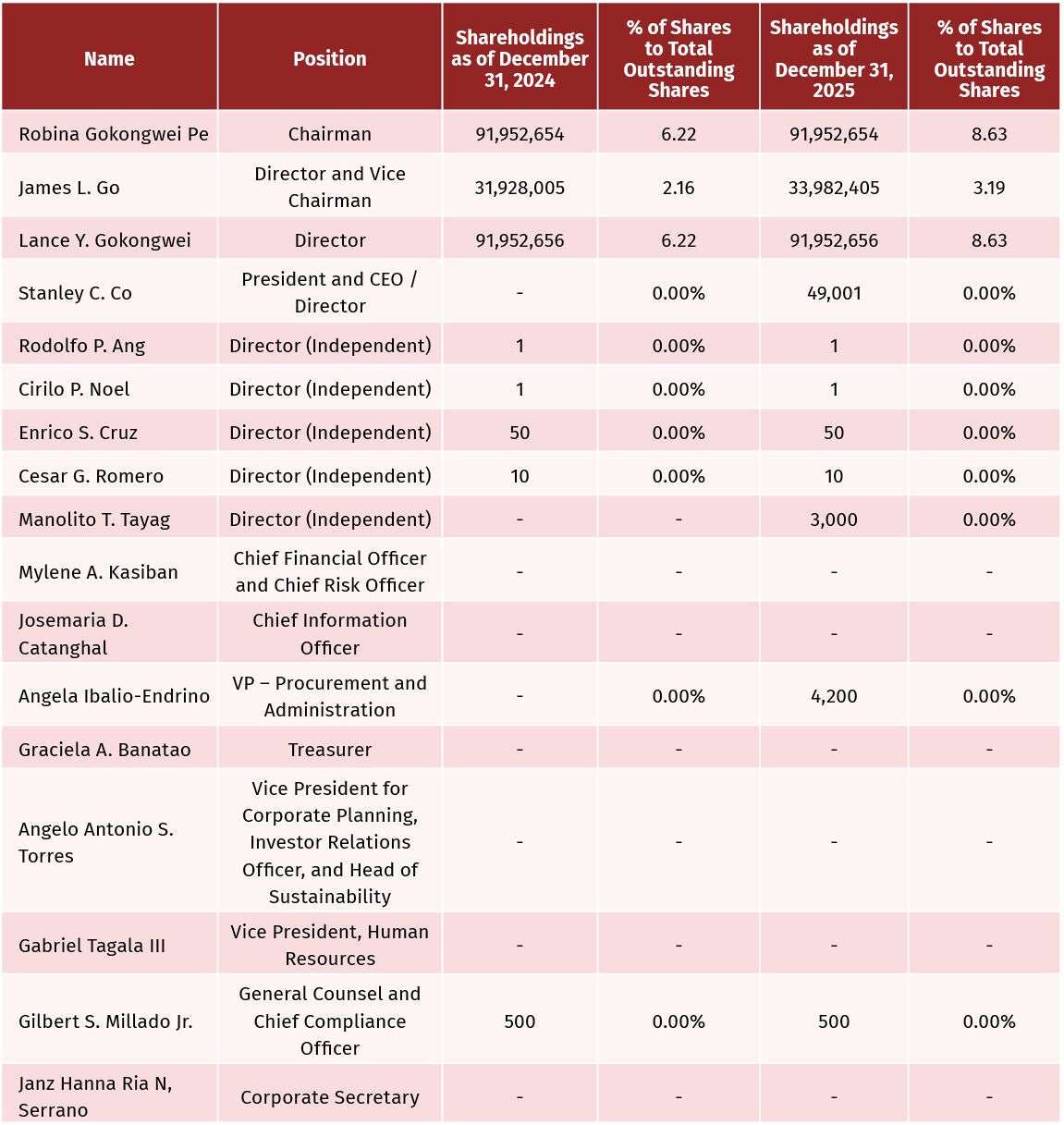
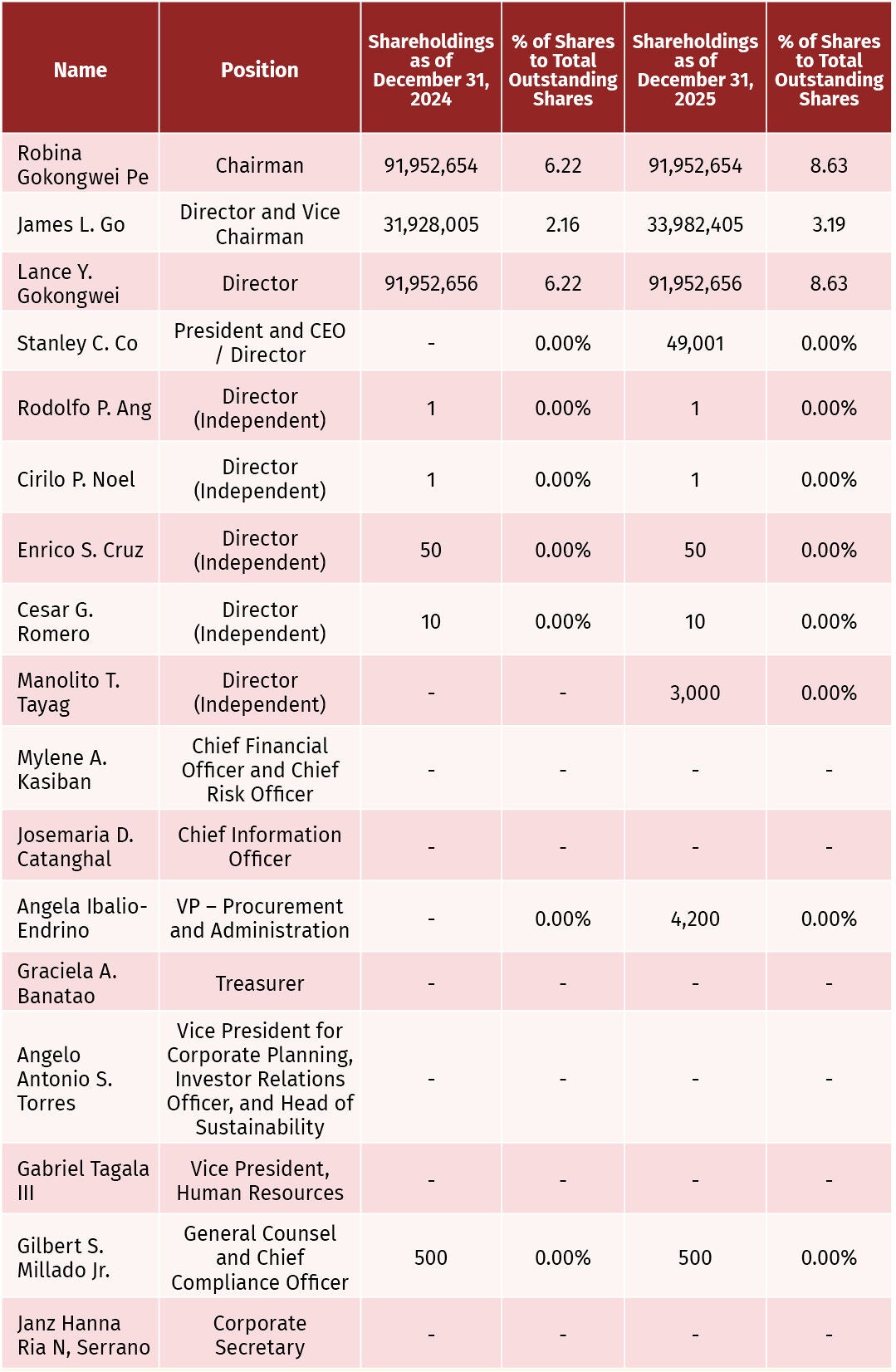
The table below sets forth the summary of trading in the
Company shares by the Directors and Key Officers for the
financial years 2024 and 2025.
 Dividend Policy
Under the Dividend Policy, the Company shall implement an
annual cash dividend payout ratio of forty percent (40%) of
its audited consolidated net income attributable to parent
for the preceding fiscal year subject to compliance with the
requirements of applicable laws and regulations, the terms
and conditions of its outstanding loan facilities and the
absence of circumstances which may restrict the payment of
such amount of dividends, including, but not limited to,
instances wherein the Company proposes to implement and
undertake major projects and developments through its
subsidiaries. There can be no guarantee that the Company
will pay dividends in the future.
The Company observes a 30-day period for distributing
dividends following the declaration date of dividends.
The Company updates the public with operating and financial
results through timely disclosures filed with SEC and PSE.
These are available on the company’s website:
https://www.robinsonsretailholdings.com.ph/